
Overview
The B2C Prospect Combined Lead Score uses HubSpot’s combined scoring system to evaluate contacts based on:
-
Prospect Fit (how qualified the contact appears)
-
Prospect Engagement (how actively the contact interacts with marketing or sales)
These two dimensions are combined to create the B2C Prospect Combined Lead Score, which determines prospect priority.
The model uses threshold tiers and a distribution grid to categorize contacts and guide prioritization.
Score Properties & Limits
The scoring model creates three HubSpot contact properties.
| Property | Purpose | Range |
|---|---|---|
| B2C Prospect Fit Score | Measures how well the contact matches the ideal prospect profile | -200 to 200 |
| B2C Prospect Engagement Score | Measures marketing and sales interaction activity | -200 to 200 |
| B2C Prospect Combined Lead Score | Total score combining fit and engagement signals | -400 to 400 |
The combined score is the primary score used for segmentation and prioritization.
Threshold Framework
Contacts are grouped into tiers based on their Fit Score and Engagement Score.
Fit Score Thresholds
| Tier | Score Range | Meaning |
|---|---|---|
| A | 22–200 | Strong prospect fit |
| B | 12–21 | Moderate prospect fit |
| C | -400–11 | Low fit or unknown qualification |
Fit evaluates how closely the contact aligns with the organization’s ideal prospect profile.
Engagement Score Thresholds
| Tier | Score Range | Meaning |
|---|---|---|
| 1 | 50–200 | High engagement |
| 2 | 25–49 | Moderate engagement |
| 3 | -400–24 | Low engagement |
Engagement reflects behavioral signals such as:
-
Form submissions
-
Website visits
-
Email interaction
-
Sales communications
Combined Threshold Grid
Contacts are placed into a scoring grid.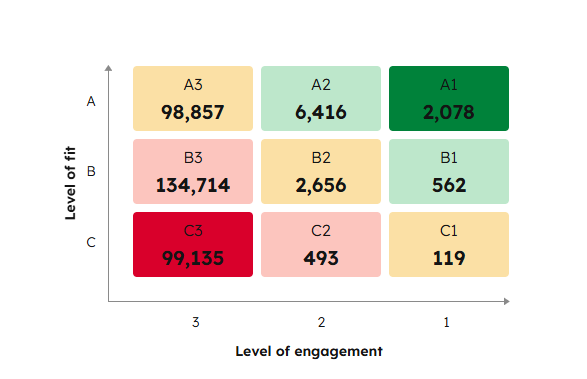
Each segment represents a different level of priority.
Distribution Insights
Based on the score distribution preview as of March 2026:
Engagement Distribution
Approximately:
-
~62% of contacts fall into low engagement (Tier 3)
-
~27% fall into moderate engagement (Tier 2)
-
~10% fall into high engagement (Tier 1)
This pattern is typical for inbound databases where most contacts have minimal interaction.
Fit Distribution
Approximately:
-
~57% of contacts fall into high-fit (Tier A)
-
~34% fall into moderate-fit (Tier B)
-
~9% fall into low-fit (Tier C)
This indicates the majority of contacts align reasonably well with the ideal prospect profile.
Combined Distribution Insights
The combined scoring grid reveals how contacts are distributed across the prioritization model.
Key insights include:
-
The largest segment (~30%) consists of A3 contacts, which are good-fit prospects who have not yet shown meaningful engagement.
-
High-priority prospects (A1) represent approximately 8% of contacts, indicating a focused group for sales outreach.
-
Moderate opportunity segments (A2, B1, B2) collectively represent roughly 28% of contacts, forming a strong pool for nurture campaigns and sales follow-up.
-
Low-priority segments (C3, B3) together represent approximately 32% of contacts, indicating contacts that require long-term nurturing or additional qualification.
Key Takeaway
The threshold system helps translate raw lead scores into actionable priority tiers, allowing teams to quickly determine which prospects should receive:
-
Immediate sales outreach
-
Marketing nurturing
-
Lower priority engagement